


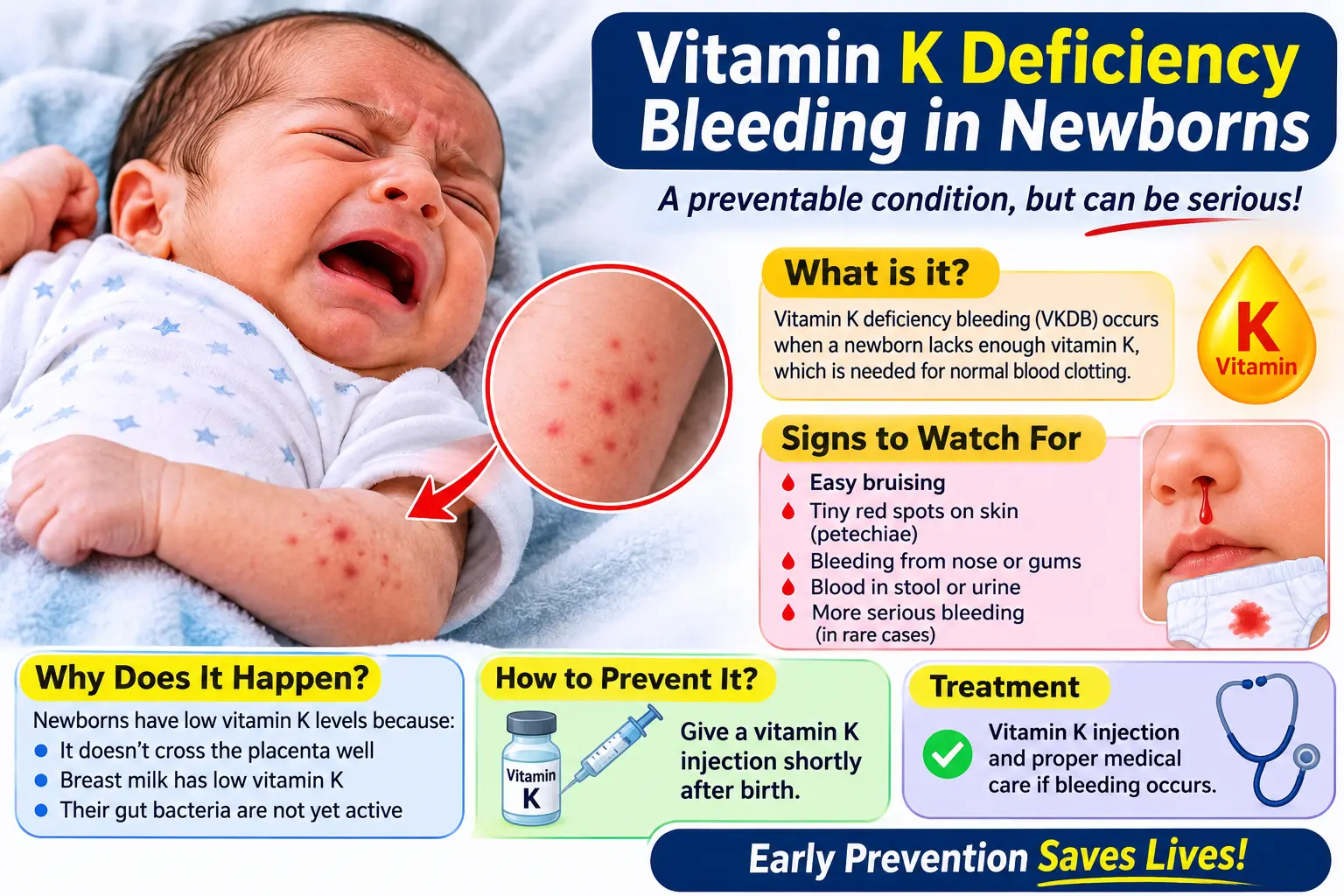
Almost every baby is born with very little vitamin K, the nutrient the body needs to form blood clots. Pediatricians have recommended a single vitamin K shot for all newborns since 1961, yet the American Academy of Pediatrics (AAP) has reported an increase in cases of vitamin k deficiency bleeding (VKDB), partly because more parents are declining the shot. This guide explains what VKDB is, how to recognize the signs, which babies are at higher risk, and how to prevent it, based on guidance from the CDC and AAP. It’s meant to help you ask informed questions, and your baby’s pediatrician is the best person to answer them.
Vitamin k deficiency bleeding is a bleeding disorder in infants whose blood doesn’t have enough vitamin K to form clots. It can occur up to 6 months of age, often with no warning signs, and may cause bleeding in the brain. A single vitamin K shot given soon after birth prevents it. If a baby has unusual bleeding, extreme sleepiness, or seizures, seek emergency care.
What Is Vitamin K Deficiency Bleeding?
It’s a condition in which a baby’s blood lacks enough vitamin K to form clots, so bleeding inside or outside the body is hard to stop.
Vitamin K helps the blood clot and stop bleeding. We get it from food, and good bacteria in the intestines make some too. Newborns start life with very small stores: only a little crosses the placenta, their gut bacteria haven’t developed yet, and breast milk contains little. When levels are too low, bleeding can happen anywhere. Inside the body, it can be hard to notice, and it commonly occurs in the intestines or the brain, which can cause brain damage or death. According to the CDC, babies who don’t get the shot at birth can develop vitamin k deficiency bleeding at any time up to 6 months of age. The AAP reports that about 1 in 5 babies with a serious bleed from this condition die.
What Are the Types of Vitamin K Deficiency Bleeding?
Doctors group it by age: early (first 24 hours), classical (2 days to 1 week), and late (1 week to 6 months).
| Type | When it occurs | Characteristics |
|---|---|---|
| Early-onset | Within 24 hours of birth | Severe; mostly in babies whose mothers took certain medicines (such as seizure medicines or isoniazid) that interfere with vitamin K |
| Classical | 2 days to 1 week | Bruising; bleeding from the umbilical cord |
| Late-onset | 1 week to 6 months, most often 2–8 weeks | 30–60% have bleeding in the brain; most common in exclusively breastfed babies who didn’t get the shot; warning bleeds are rare |
The CDC reports that early and classical types occur in about 1 in 60 to 1 in 250 newborns, with a much higher risk for early-onset when mothers took those medicines, while late-onset is rarer, at about 1 in 14,000 to 1 in 25,000 infants. Babies who don’t receive the shot are 81 times more likely to develop the late type.
What Are the Signs and Symptoms of Vitamin K Deficiency Bleeding?
Often there are none before a serious bleed. Look for bruises, nose or cord bleeding, pale skin, yellow eyes, bloody stool, or seizures.
In most cases, the CDC says, there are no warning signs before a life-threatening event begins. Signs that may appear include:
- Bruises, especially on the head and face
- Bleeding from the nose or umbilical cord
- Skin that looks paler than before (for babies with darker skin, the gums may look pale)
- Yellow whites of the eyes after the first 3 weeks of life
- Blood in the stool, black and sticky (“tarry”) stool, or vomiting blood
- Irritability, seizures, excessive sleepiness, or a lot of vomiting, which can signal bleeding in the brain
Suspected internal bleeding is an emergency. Don’t wait if you suspect vitamin k deficiency bleeding: call 911 or go to the nearest emergency department.
What Are the Risk Factors for Vitamin K Deficiency Bleeding?
All newborns are at risk until they eat regular foods. Missing the shot, certain maternal medicines, and liver or gut disease raise the risk further.
Every infant, regardless of sex, race, or background, is at higher risk until they start regular foods, usually around 4 to 6 months, and until normal gut bacteria begin making vitamin K. Babies at greater risk include:
- Babies who don’t get the vitamin K shot, and especially those who are exclusively breastfed, since breast milk contains only small amounts
- Babies whose mothers took medicines such as isoniazid or seizure medicines during pregnancy
- Babies with liver disease, who often can’t use stored vitamin K
- Babies with diarrhea, celiac disease, or cystic fibrosis, who can have trouble absorbing vitamins from food
How Can You Prevent Vitamin K Deficiency Bleeding?
A single vitamin K shot into the thigh muscle soon after birth. It can be delayed up to 6 hours for early bonding.
The CDC calls the shot the way to prevent vitamin k deficiency bleeding: one injection into a muscle in the thigh just after birth protects your baby. To allow immediate skin-to-skin time, it can be given up to 6 hours after birth. The AAP has recommended it for all newborns since 1961, as the HealthyChildren.org policy summary explains. Some parents ask about vitamin K by mouth, but babies don’t absorb it as reliably, and the AAP says oral doses are less effective and would need to be repeated over months. If your baby didn’t get the shot, call your pediatrician right away to discuss options, and if you’re planning a home birth, ask your midwife how vitamin K will be given. Tell your care team if you take seizure medicines or isoniazid.

Is the Vitamin K Shot Safe?
Yes. Studies show it’s safe for newborns, and the AAP and CDC recommend it for every baby.
The shot has been used routinely for decades. It isn’t a vaccine; it’s a nutrient. According to the AAP, part of the dose is absorbed right away, and the rest is stored in the liver and released slowly, giving a steady supply. A 1990s study raised a question about a possible link to childhood cancer; researchers took it seriously, and the AAP and CDC continue to recommend the shot. Wanting reassurance about routine newborn care is normal, and the CDC’s FAQ answers common questions. Medical literature describes a Tennessee cluster in which four babies who never received vitamin K developed sudden bleeding between 6 and 15 weeks of age, three of them in the brain, an illustration of why the shot prevents vitamin k deficiency bleeding.
Frequently Asked Questions
Can vitamin k deficiency bleeding happen without any warning?
Yes. In most cases there are no warning signs before a serious bleed, which is why prevention matters so much.
Is the vitamin K shot a vaccine?
No. It’s a nutrient given by injection. For vaccines in older children and teens, see our meningitis vaccine guide.
Can vitamin K be given by mouth instead?
Oral vitamin K isn’t absorbed as reliably, and the AAP says it’s less effective and must be given repeatedly over several months.
Key Takeaways
- vitamin k deficiency bleeding occurs when a baby’s blood lacks the vitamin K needed to clot, and it can strike up to 6 months of age.
- Most cases have no warning signs, and the brain is a common site of bleeding.
- A single vitamin K shot soon after birth prevents it, and the AAP and CDC recommend it for all newborns.
- Seek emergency care for seizures, extreme sleepiness, repeated vomiting, or bleeding you can’t stop.
Conclusion
Understanding vitamin k deficiency bleeding comes down to a few facts: newborns are born with low vitamin K, the bleeding can come without warning, and one shot at birth prevents it. If you have questions or concerns about the shot, talk with your baby’s pediatrician or your birth team before delivery, and call right away if your baby missed it or shows any signs of bleeding. For more wellness guides, visit our homepage.
