


Introduction
Most parents have never seen measles, and that is the problem. In 2026, the United States has recorded more cases of measles symptoms than in any year since 1991, and young children are the group most likely to become seriously ill. Doctors stress that measles can look like a bad cold at first, so early warning signs are easy to miss. This guide explains each stage of illness, how to tell it from other childhood rashes, when symptoms become an emergency, and how vaccination protects your child. Information comes from the CDC, Harvard Health, the MSD Manual, and the Mayo Clinic. It is general education, not a diagnosis.
What Are the First Measles Symptoms in Children?
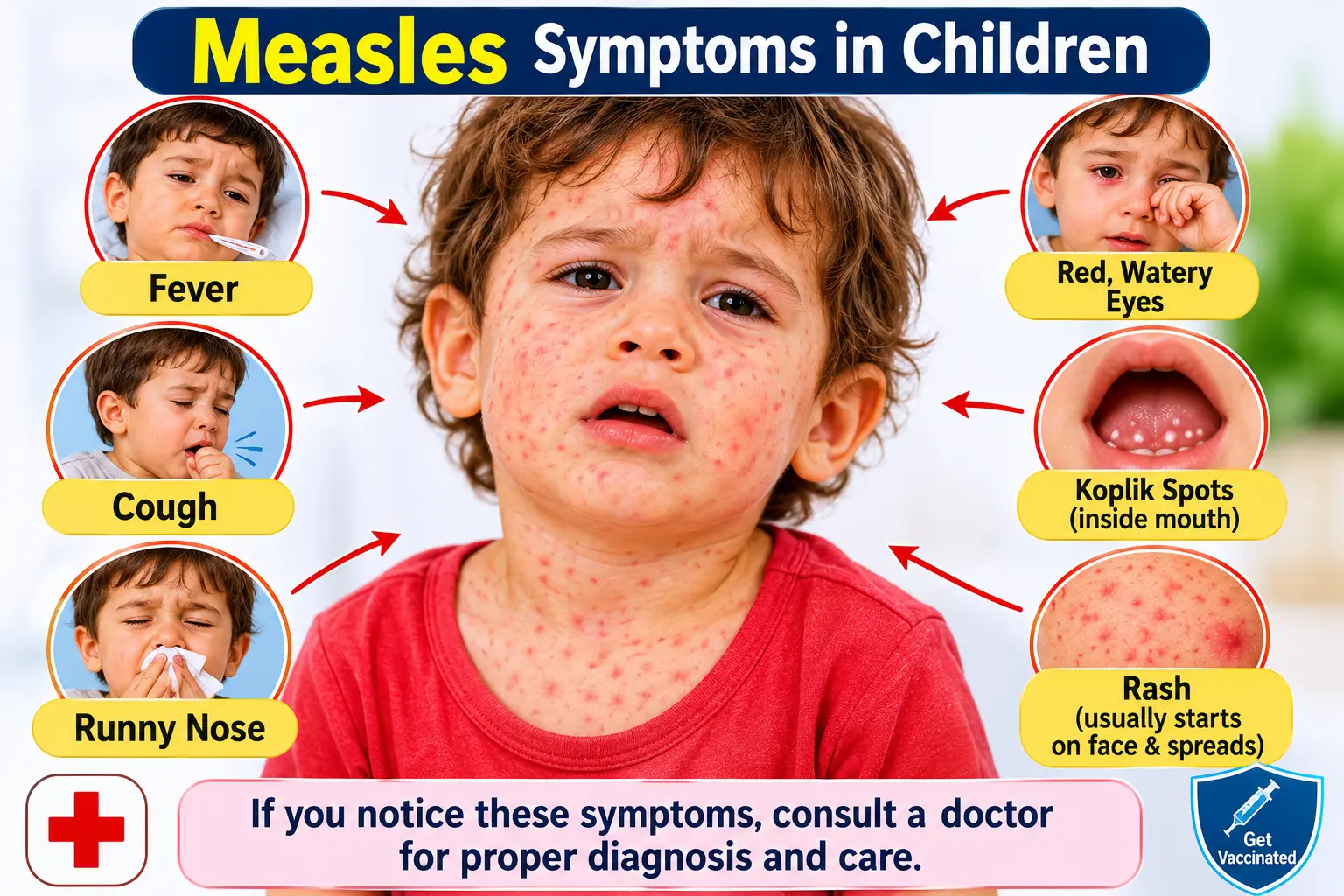
The first measles symptoms in children look like a heavy cold: high fever, cough, runny nose, and red, watery eyes, appearing 7 to 14 days after exposure.
According to the CDC’s symptom guide, the illness begins with:
- High fever, which may spike above 104°F once the rash appears
- Cough
- Runny nose (coryza)
- Red, watery eyes (conjunctivitis)
- Sore throat and tiredness in many children
Two to three days into the illness, tiny white spots (Koplik spots) may appear inside the cheeks. The MSD Manual describes them as bright red spots with white or bluish-white centres, a little like grains of sand. Because this stage resembles a common cold or flu, measles is often only suspected once a child has a known exposure or the rash appears.
What Does the Measles Rash Look Like, and When Does It Appear?
The measles rash appears 3 to 5 days after the first symptoms, starting as flat red spots at the hairline and face, then spreading downward over several days.
The rash is the symptom most parents recognise, but it is not the first. Key features:
- Starts at the hairline and face, then spreads to the neck, trunk, arms, legs and feet
- Flat red spots, sometimes with small raised bumps on top
- Spots may join together into blotchy patches as the rash spreads
- Usually not itchy, according to Harvard Health
- Fever often peaks when the rash first appears
- Skin may peel slightly as the rash fades
A rash lasts about 5 to 6 days. The Mayo Clinic’s overview notes that children with weakened immune systems can be very sick without developing a typical rash, so do not rely on the rash alone.
How Long Do Measles Symptoms Last in Children?
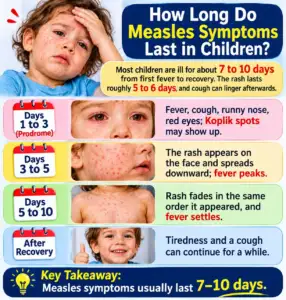
Most children are ill for about 7 to 10 days from the first fever to recovery. The rash lasts roughly 5 to 6 days, and cough can linger afterwards.
A typical timeline looks like this:
- Days 1 to 3 (prodrome): fever, cough, runny nose, red eyes; Koplik spots may show up
- Days 3 to 5: the rash appears on the face and spreads downward; fever peaks
- Days 5 to 10: rash fades in the same order it appeared, and fever settles
- After recovery: tiredness and a cough can continue for a while
If the fever keeps rising after the rash has spread, or the child seems to get worse rather than better, that may signal a complication such as pneumonia or an ear infection. Report it to your doctor promptly.
How Is Measles Different From Other Childhood Rashes?
Measles combines a high fever, cough, red eyes, and a rash that starts on the face and spreads down. Many other rashes lack that pattern, but only a test can confirm it.
Doctors consider measles when a child has a fever and rash plus cough, runny nose, or red eyes, especially with recent travel, an outbreak nearby, or no vaccination. Other childhood illnesses, such as roseola, rubella or viral rashes, can look similar. Because measles symptoms overlap with these conditions, diagnosis is confirmed by lab testing (a throat or nose swab and a blood test). If you suspect measles, call ahead so the clinic can arrange testing without exposing other patients. Report suspected cases to your local health department, as the CDC advises clinicians to do.
What Complications Can Measles Cause in Children?
Ear infections affect about 1 in 10 children with measles. Pneumonia affects up to 1 in 20 and is the most common cause of measles deaths in young children.
The CDC’s complications page lists the risks:
- Ear infection: about 1 in 10 children, which can lead to permanent hearing loss in some cases
- Diarrhoea and dehydration: common, especially in young children
- Pneumonia: as many as 1 in 20 children
- Croup and airway inflammation: can make breathing difficult
- Encephalitis (brain swelling): about 1 in 1,000 children
- Death: 1 to 3 of every 1,000 infected children, mostly from respiratory and neurological complications
Children under 5 face the highest risk. The CDC also notes that measles can weaken the immune system for a period afterwards, leaving children more vulnerable to other infections.
When Should You Call a Doctor or Go to the ER?
Call your doctor right away if you suspect measles. Go to emergency care for breathing difficulty, seizures, extreme drowsiness, dehydration, or a fever that won’t come down.
Call your pediatrician or local health department the same day if your child has a fever and rash and may have been exposed. Seek emergency care for:
- Fast, laboured or noisy breathing
- Seizure or convulsion
- Unusual sleepiness, confusion or being hard to wake
- Signs of dehydration: very few wet nappies or no urine for 8 hours, no tears, dry mouth
- Severe headache, stiff neck or sensitivity to light
- Persistent high fever or worsening ear pain
Always phone ahead before visiting a clinic or hospital so staff can isolate your child on arrival and protect other patients, especially infants and anyone with a weak immune system.
How Contagious Is Measles, and How Does It Spread?
Measles is extremely contagious. It spreads through the air when an infected person coughs or sneezes, and the virus can linger in a room for up to 2 hours.
A child can pass on measles from about 4 days before the rash appears to 4 days after, which means they can spread it before anyone knows what the illness is. Nearly all unvaccinated people who are exposed will catch it. Infants too young for vaccination, pregnant women without immunity, and people with weakened immune systems are especially at risk. Keep a sick child home from school, daycare, and public places until a doctor says the infectious period is over. The CDC’s overview of measles data tracks cases and outbreaks across the country.
How Are Measles Symptoms Treated at Home?
There is no antiviral for measles. Care means rest, fluids, fever relief, monitoring, and a doctor’s guidance. Never give aspirin to a child with measles.
Doctors treat the symptoms while the body clears the infection:
- Fluids: frequent small drinks, breast milk or formula for infants, and oral rehydration solution if there is diarrhoea
- Rest in a quiet, dim room if light bothers the eyes
- Fever relief: acetaminophen or ibuprofen at doses suited to your child’s age and weight, as directed by your doctor. Do not use aspirin because of the risk of Reye’s syndrome, a rare liver and brain condition
- Vitamin A: may be prescribed by a doctor for children hospitalised with measles, especially those aged 6 months to 2 years. Do not give it yourself
- Isolation at home and close follow-up with your doctor
Treating measles symptoms at home is only safe with medical supervision, because complications can develop quickly.
How Can You Protect Your Child in 2026?
Two doses of the MMR vaccine are about 97% effective against measles. Children usually get the first dose at 12 to 15 months and the second at 4 to 6 years.
The situation this year makes protection urgent. The CDC reported 5,412 confirmed U.S. cases as of 12 November 2026, according to Contagion Live, with about 11% of cases hospitalised. State health departments have reported about 10 measles-associated deaths this year, including infants, though counts differ between sources. Reports say the Pan American Health Organization has found that the U.S. lost its measles elimination status, with a formal announcement expected on 17 November, as Healthline reported. Roughly 96% of this year’s cases were in people who were unvaccinated or whose status was unknown. Pennsylvania, home to one of the largest outbreaks, publishes live numbers on the state health department’s measles page.
Practical steps:
- Check your child’s records and confirm both MMR doses are documented
- Ask about an early dose if your infant is 6 to 11 months and you are travelling internationally or live in an outbreak area; your doctor or health department can advise
- Catch up on any missed doses; it is never too late
- Support overall health with good sleep (sleep and recovery tips), balanced meals (immune-supporting foods) and hydration (hydration guide), while remembering these do not replace vaccination
- Keep sick children home and call ahead before any medical visit
Frequently Asked Questions
What are the first signs of measles in a child?
High fever, cough, runny nose, and red, watery eyes, followed by a rash 3 to 5 days later.
Does the measles rash itch?
Usually not. The rash is typically non-itchy, flat red spots that may join together.
How long is a child with measles contagious?
From about 4 days before the rash appears until 4 days after it appears.
Can a vaccinated child get measles?
Rarely. Two MMR doses are about 97% effective, and vaccinated children who do catch it usually have milder illness.
Can you treat measles symptoms at home?
Only with a doctor’s guidance. Rest, fluids and fever relief help, but complications need medical care.
Conclusion
Measles begins like a cold, brings a high fever and red eyes, and then shows its trademark rash that starts on the face and spreads down. Knowing the timeline helps you act early: call your doctor before visiting, keep your child home, and watch closely for breathing trouble, dehydration, or unusual drowsiness. With cases at a 35-year high, the single best defence is checking that your child has had both MMR doses. If you are unsure about your child’s vaccination record or suspect exposure, speak with your pediatrician today, and share this guide with other parents.
