


Share This Article
Building muscle at home, bulk up, recomp (build muscle and lose fat), or keep your strength, choose what you want while leaning out. Strength can be built up quickly by beginners, but visible size takes weeks to months to develop. You won’t “bulk up” in a week, but you can master technique, nutrition, and a routine that gets you moving.
What Are the Basics of Building Muscle at Home?
Hypertrophy requires progressive overload (increasing reps, sets, or load), sufficient volume (10–20 hard sets per muscle weekly), and recovery (7–9 hours sleep and proper nutrition). Three things are required for hypertrophy:
- progressive overload, which involves gradually increasing the intensity of workouts (more reps, sets, load, range, or slower tempo).
- Sufficient volume: typically between 10 and 20 hard sets per muscle, across all exercises, per week.
- Recovery: sleep 7–9 hours, manage stress, and fuel appropriately.
How to Choose a Workout Split for Home Muscle Building?
Train full body 3 days/week or upper/lower 4 days/week. Full body is simplest at home. Include lower push, lower pull, push, pull, and core exercises in each session. Train full body 3 days/week or upper/lower 4 days/week. Full body is simplest at home.
Template for the entire body
- Lower push: squats/split squats
- Lower pull: hip hinge (hip thrust, RDL pattern)
- Push: push-up or press
- Pull: row or pull-down/pull-up variation
- Core: anti-extension/rotation (plank, dead bug, side plank)
Perform 3–4 sets of 6–15 reps for each exercise. Rest 60–120 sec.
How to Build Muscle at Home Without Weights?
Use bodyweight exercises like squats, push-ups, dips, and rows with household items. Add a backpack for load. Progress by slowing tempo, adding pauses, or using single-leg variations. No equipment? Make use of household items and weight.
- Legs: Bulgarian split squats, step-ups with a backpack, hip thrusts with the sofa edge, and tempo squats (3–1–3)
- Push-ups: (hands on the floor, feet on the floor), triceps dips on chairs for shoulders, and pike push-ups are all examples of push-ups.
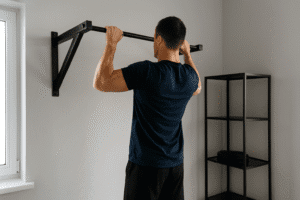
- Pull: backpack, towel, and table rows anchored in a door. If possible, add a pull-up bar.
- Levers for progress: include slower eccentrics, pauses, longer ranges, single-leg or unilateral work, and the addition of a backpack or books for load.
A doorway pull-up bar, resistance bands, and adjustable dumbbells or kettlebells are examples of minimal equipment that accelerate progress.
What Is the Right Technique for Home Muscle Building?
Choose loads where last 2–3 reps are tough but form stays clean. Increase load or reps when you hit your target range. Log every session to track progress.
- Pick loads/reps where the last 2–3 reps feel tough while form stays clean (leave 1–2 reps in reserve).
- When you hit the top of your rep range for all sets, increase load (or elevate feet, add books to backpack, slow tempo).
- Track sessions in a simple log: exercise, sets×reps, RIR, and notes.
What Diet Supports Muscle Building at Home?
Eat 1.6–2.2g protein per kg body weight. For muscle gain, add 200–300 kcal surplus; for recomposition, maintain a slight deficit. Include carbs around workouts and healthy fats.
- Protein: ~6–2.2 g per kg body weight daily (e.g., 120–165 g at 75 kg). Spread across 3–5 meals; include 20–40 g per meal.
- Calories:
- To gain muscle mass: small surplus +200–300 kcal/day.
- To build muscle and lose fat (recomp): small deficit –250 to –400 kcal/day with high protein and heavy training.
- Carbs: anchor around workouts (rice, oats, fruit, potatoes, whole grains) to fuel volume.
- Fats:6–1.0 g/kg from olive oil, nuts, eggs, fatty fish.
- Basics: 2–3 L water/day, creatine monohydrate 3–5 g/day (optional, proven), plenty of veggies, and some fruit for micronutrients.
How Can Women Build Muscle at Home?
Principles are same. Women can include glute-focused moves like hip thrusts and Bulgarian split squats. Muscle gain is gradual—you won’t “bulk up” accidentally without a surplus. Principles are identical. Females often recover well from slightly higher reps and can benefit from glute-focused moves:
- Hip thrusts, Romanian deadlifts, Bulgarian split squats, step-ups, banded abductions.
- You won’t “bulk up” by accident if you put progressive overload and enough calories first; muscle gain is gradual.
How skinny guys can build muscle at home
- Eat more frequently and choose whole foods that are high in calories, such as nuts, oats with milk, trail mix, eggs, rice, and vegetables drizzled with olive oil.
- Aim for a daily caloric intake of +300–400 kcal, protein at each meal, and a milk or yogurt-based shake after a workout. Steps for health, for example, can be considered moderate cardio, and a linear progression toward heavier fundamentals is preferred.
How Can Older Adults Build Muscle at Home?
Prioritize balance and joint-friendly ranges. Use heel-elevated squats, wall push-ups, and band rows. Keep volume moderate (8–12 sets/muscle/week) and protein high for bone health.
- Get clearance if returning from inactivity or with medical conditions.
- Balance and mobility should take precedence over speed and use of joint-friendly ranges (heel-elevated squats, supported split squats, hip hinges with a dowel, band rows, wall push-ups).
- Keep volume moderate (8–12 sets/muscle/week), extend rest as needed, and keep protein on the higher end. Vitamin D and regular walks aid in bone health and recovery.
Can You Build Muscle at Home in 1 Week?
In 7 days, learn form on key moves, complete 3 sessions, set protein targets, and establish sleep habits. Expect better connection and performance—not visible size yet. In seven days, you can:
- Learn correct form on 5–6 key movements.
- Complete 3 full-body sessions.
- Establish protein targets and a consistent meal schedule.
- Sleep 7–9 hours nightly and set up your logbook.
Expect better pumps and mind-muscle connection—not visible size yet.
What Are Signs You’re Gaining Muscle?
Look for strength increases, measurements (arms, thighs), steady weight gain (0.25–0.5 kg/week in surplus), progress photos showing muscle shape, and good recovery within 48–72 hours.
- Strength up: more reps or load at the same RIR.
- Measurements: arms, thighs, chest/hips up slightly while waist steady (for bulking) or down (for recomp).
- Body weight rising slowly (0.25–0.5 kg/week in a surplus).
- Progress photos: better muscle shape/hardness every 3–4 weeks.
- Recovery: mild soreness that resolves within 48–72 hours; constant exhaustion is a red flag.
Schedule for Building Muscle at Home with no weights
Day 1 – Full Body A
- Feet-elevated push-ups 4×6–10
- Bulgarian split squats 4×8–12/leg
- Table/broomstick rows 4×8–12
- Hip thrusts 3×10–15
- Side plank 3×30–45s/side
Day 3 – Full Body B
- Pike push-ups 4×6–10
- Backpack squats 4×10–15
- Backpack rows 4×10–15
- Single-leg RDL (bodyweight) 3×10–12/leg
- Dead bug 3×8–12/side (slow)
Day 5 – Full Body A (progress)
Repeat Day 1, add 1–2 reps per set or slow tempo to 3–1–3.
Optional: light walks on other days; keep steps 6–10k.
Pro tips for Building Muscle at Home in a week
Day 1: Goblet squat, DB RDL, DB bench/push-ups, one-arm DB row, band face pull, plank.
Day 3: Split squat, hip thrust, DB overhead press, pull-ups/band pulldown, DB curl, calf raises.
Day 5: Front-foot elevated split squat, DB RDL pause reps, incline push-up/DB press, chest-supported row, triceps extensions, ab-wheel/rollouts.
Use 6–12 reps for main lifts and 10–15 for accessories; progress weekly.
Building Muscle at Home and Losing Fat
- Train each muscle two to three times per week at a high intensity.
- Maintain high protein and a small calorie deficit.
- Use photos, measurements, and progressive overload to judge, but accept slower scale changes.
- If you want, you can add two 20- to 30-minute low-impact cardio sessions, but don’t let them slow down leg recovery.
Conclusion
- Train full body or upper/lower consistently 3–4×/week.
- Log every session; aim to beat last week by a rep, load, or tempo.
- Hit protein 1.6–2.2 g/kg and choose surplus vs. deficit based on your goal.
- Sleep 7–9 hours, hydrate, and manage stress.
- Reassess every 4 weeks using strength logs, measurements, and photos.
- Adjust volume (add or subtract 2–4 sets/week per muscle) based on recovery and progress.
- Stay patient—steady progression beats random intensity.
