


Share This Article
What Is Meditation and How Does It Work?
Meditation is a trainable skill focusing the mind on the present moment. It involves noticing thoughts without judgment and returning to an anchor—often the breath—to build mental clarity and emotional balance. Meditation is a trainable skill that focuses the mind and gently returns attention to the present moment. In practice, it means noticing thoughts, feelings, and sensations without judgment—then choosing an anchor (often the breath) to steady awareness. Over time, this builds mental clarity, emotional balance, and a calmer baseline.
What Are the Key Benefits of Meditation?
Meditation sharpens focus, reduces emotional reactivity, lowers perceived stress, improves sleep quality, and promotes intentional choices and kinder communication through consistent practice.
- Mental: sharper focus, better memory consolidation, less mind-wandering.
- Emotional: reduced reactivity, improved mood, greater resilience.
- Physical: lower perceived stress, steadier heart rate and breathing, improved sleep quality.
- Behavioral: more intentional choices and kinder communication.
These gains come from consistency, not intensity—think minutes per day, not marathon sessions.
What Are the Different Types of Meditation?
Types include Mindfulness (open awareness), Focused Attention (breath/sound), Loving-Kindness (Metta), Body Scan, Mantra, Walking/Movement, and Yoga Nidra. Choose one daily for 2–4 weeks.
- Mindfulness (Open Awareness): observe thoughts and sensations as they arise, then let them pass.
- Focused Attention: rest attention on one object (breath, sound, candle flame).
- Loving-Kindness (Metta): cultivate goodwill using phrases like “May I be peaceful; may others be peaceful.”
- Body Scan: move attention steadily from head to toe, noticing sensations.
- Mantra: repeat a word/phrase to quiet mental noise.
- Walking/Movement: slow, deliberate steps or gentle movement while staying aware.
- Yoga Nidra: guided, deeply restful practice hovering between wakefulness and sleep.
Choose one primary style and revisit it daily for 2–4 weeks before switching.
What Are the Basic Techniques for Starting Meditation?
Sit upright in a quiet spot, close your eyes, and focus on your breath. When the mind wanders, label it “thinking” and gently return. Begin with 5 minutes daily.
- Set your space: quiet corner, phone on do-not-disturb, soft light.
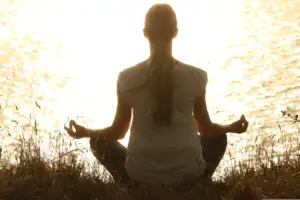
- Posture: sit upright on a chair or cushion, shoulders relaxed, chin slightly tucked, hands resting comfortably. Lying down is fine for sleep practices.
- Anchor: most people start with the breath—feel the air at the nostrils or belly rising/falling.
- Attitude: Be curious and kind. Distraction isn’t failure; it’s a cue to return.
- Method:
- Close the eyes or lower the gaze.
- Take one slow breath in and out.
- Notice sensations of breathing.
- When the mind wanders (it will), label it “thinking” or “hearing,” then gently return to the anchor.
- Timing: begin with 5 minutes, build to 10–15 minutes most days.
- Finish: take one deliberate breath, open the eyes, and carry a thread of awareness into your next action.
Micro-practice (60 seconds): pause, feel both feet, inhale for a slow count of 4, exhale for 4, repeat 5–7 times.
How Can Beginners Start a Meditation Practice?
Start with 5 minutes of breath awareness, gradually adding a body scan and loving-kindness. Track mood and focus for two weeks; shorten sessions if restless or sit upright if sleepy.
- Day 1–2: 5 minutes of breath awareness. Count breaths 1–10; restart when you lose count.
- Day 3: 7 minutes, add a 1-minute body scan at the end.
- Day 4: 8–10 minutes, try labeling—“thinking,” “planning,” “itching”—then return.
- Day 5: 10 minutes, finish with 2 minutes of loving-kindness for yourself.
- Day 6: 10–12 minutes, include 2 minutes of loving-kindness for someone you appreciate.
- Day 7: 12–15 minutes, choose your favorite elements and combine them.
Common Hurdles
restlessness (shorten sessions), sleepiness (sit more upright, try morning), doubt (“Is this working?”—track mood/focus for two weeks).
What Is a Good Morning Meditation Routine?
A 10-minute morning flow includes stretching, breath priming (inhale 4/exhale 6), focused breath work, and setting an intention like “patient” or “kind.” Link it to a morning trigger. Morning practice clears overnight mental residue and sets intentions before the day’s demands arrive.
10-Minute Morning Flow
- Wake check (30s): sip water, stretch neck/shoulders.
- Seat (30s): comfortable upright posture.
- Breath priming (2 min): inhale 4, exhale 6.
- Focus (6 min): rest on breath; when distracted, return with kindness.
- Intention (1 min): choose a word—“patient,” “steady,” or “kind.”
Tip: link it to a trigger (after brushing teeth) to build a rock-solid habit.
How Can Meditation Help with Sleep?
A pre-sleep body scan (8–12 min) moves attention from toes to scalp. Yoga Nidra is ideal when wired. The 4-7-8 breathing pattern (inhale 4, hold 7, exhale 8) also aids relaxation. Evening practice aims to downshift the nervous system.
Pre-sleep Body Scan (8–12 min)
- Lie on your back, legs extended or knees bent.
- Move attention from toes to scalp in small zones; note warmth, coolness, pressure.
- If thoughts speed up, re-anchor to the sensation of the mattress beneath you.
Yoga Nidra Option: use a guided script to cycle awareness through the body and breath; it’s ideal when you’re wired but tired.
Breathing aid: try a gentle 4-7-8 pattern (inhale 4, hold 7, exhale 8) for 4–6 rounds. If you feel light-headed, shorten the counts.
If persistent insomnia continues, pair meditation with good sleep hygiene or speak to a professional.
What Meditation Techniques Help with Anxiety?
Grounding (name 5 things you see, 4 feel, 3 hear), Box Breathing (inhale 4, hold 4, exhale 4, hold 4), and Compassionate Labeling (“anxiety is here”) help you relate differently to anxious feelings. The goal isn’t to erase anxiety but to relate to it differently.
Grounding (2 min):
- Name 5 things you see, 4 you feel, 3 you hear, 2 you smell, 1 you taste.
Box Breathing (3–5 min):
- Inhale 4, hold 4, exhale 4, hold 4; repeat 6–10 cycles.
Compassionate Labeling:
- When a wave hits, note “anxiety is here,” place a hand on the chest, and lengthen exhale.
- Add a Metta line: “May I feel safe. May I feel at ease.”
Practice these before high-stress moments so they’re easier to access when needed.
How Can You Combine Meditation and Yoga?
A pre-sit sequence like Cat-Cow, Forward Fold, Child’s Pose, and alternate-nostril breathing prepares the body for meditation. Mindful walking helps on restless days; standing mountain pose helps on sleepy days. Yoga prepares the body for sitting; meditation clarifies the mind. Yoga awakens. A simple pre-sit sequence:
- Cat–Cow (60–90s): mobilize spine with slow breath.
- Forward Fold or Half Lift (60s): lengthen the back of legs, release neck.
- Child’s Pose (60–120s): relax hips and shoulders.
- Pranayama (2–3 min): gentle alternate-nostril breathing to balance attention.
- Sit (10 min): move into your chosen meditation.
On restless days, try a mindful walking meditation first; on sleepy days, hold a standing mountain pose for 60 seconds before sitting.
How to Build a Complete Meditation Routine?
Choose an anchor (breath, body, sound), practice 5–15 minutes most days, and integrate micro-practices (e.g., 3 slow breaths before email). Rotate styles every 2–4 weeks.
- Anchor: breath, body, or sound.
- Method: focus → distraction → gentle label → return.
- Length: 5–15 minutes, most days.
- Rotation: one primary style for 2–4 weeks, then refine.
- Support: timer, soft bell, or brief guidance (headphones optional).
- Integration: pick one micro-practice to repeat during the day (e.g., 3 slow breaths before email, a 60-second stand-and-feel break between tasks).
Conclusion
Progress isn’t measured by “perfect calm” but by shorter recovery time when you’re stressed, clearer choices, and a kinder inner voice. Keep a tiny log (minutes, type, one word on mood). If you miss a day, restart the next—no guilt needed. When you’re ready, deepen your practice with longer loving-kindness sessions, weekly Yoga Nidra, or a community class for accountability.
