


-
What Is the Correct Form for a Push Up?
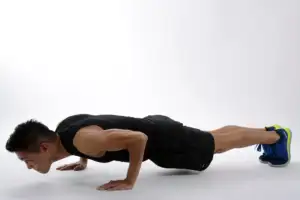
Keep hands slightly wider than shoulders, maintain a straight line from head to heels, lower chest close to the floor with elbows at 45 degrees, and engage your core. Push Up are one of the most effective bodyweight exercises. However, many people perform them incorrectly, which reduces results and increases the risk of injury. Mastering the push-up correct form is the foundation for every variation.
- Keep your hands slightly wider than shoulder width.
- Maintain a straight line from head to heels.
- Lower your chest close to the floor while keeping your elbows at 45 degrees.
- Engage your core and avoid sagging hips.
Learning the right push-up form ensures you activate the chest, shoulders, triceps, and core effectively.
-
What Muscles Do Push Ups Work?
Push ups primarily target the chest (pectorals), triceps, shoulders (deltoids), core muscles, and back stabilizers, making them a compound exercise. Many people ask: push-ups work what muscles? This exercise is a compound movement targeting multiple groups.
- Chest (Pectorals) – main driving force.
- Triceps – pushing power.
- Shoulders (Deltoids) – stability and strength.
- Core muscles – balance and posture.
- Back stabilizers – proper alignment.
This makes push-ups ideal for building overall strength without equipment.
-
How Can Push Ups Target the Chest and Triceps?
To target the chest, use a wider hand placement. To focus on triceps, perform diamond or close-grip push ups. Mix both for balanced upper body strength. Different variations can emphasize specific muscles. For example:
- Push up for chest – wider hand placement, slow controlled movement.
- Push up for triceps – diamond push up or close grip position.
By mixing both, you can build a balanced upper body.
-
What Are the Best Push Up Variations?
Popular variations include pike push-ups (shoulder-focused), decline push-ups (upper chest), Spiderman push-ups (core), and clap push-ups (explosive power). Once you master the basics, you can try push-up variations to increase intensity. Popular options include:
- Pike push-up (shoulder-focused).
- Decline push-up (upper chest).
- Spiderman push-up (core activation).
- Clap push-up (explosive power).
These add challenge, prevent boredom, and enhance strength gains.
-
How Do You Perform a Pike Push Up?
Start in a downward dog position, bend your elbows to lower your head toward the ground, then push back up. This variation strongly targets the shoulders. A popular variation is the pike push-up. It targets the shoulders more than the chest.
How to do it:
- Start in the downward dog position.
- Bend elbows and lower head toward the ground.
- Push back up to the starting position.
This movement is a great alternative to overhead pressing when no weights are available.
-
What Is a Wall Push Up for Beginners?
Stand facing a wall, place palms at chest level, bend elbows to bring chest close, and push back. This modification reduces strain while building initial strength. Not everyone can do full floor push-ups initially. Push-up on the wall is a perfect modification.
- Stand facing a wall.
- Place palms on the wall at chest level.
- Bend your elbows and bring your chest close.
- Push back to the starting position.
This reduces strain while still building strength.
-
Do Push Up Boards and Handles Help?
Push-up boards offer angled grip positions, and handles reduce wrist pressure. Both tools enhance comfort, range of motion, and training versatility. Equipment can improve performance and reduce wrist discomfort.
- Push-up board – offers different angles and grip positions to target chest, shoulders, and triceps.
- Push-up handles – allow a deeper range of motion and reduce pressure on wrists.
Both tools can make training safer and more versatile.
-
What Are the Benefits of Push Up Bars?
Push-up bars increase range of motion, improve chest stretch, reduce wrist pain, and enhance muscle activation for advanced strength training. Similar to handles, push-up bars elevate your hands, increasing the range of motion. Benefits include:
- Better chest stretch.
- Reduced wrist pain.
- Improved muscle activation.
Athletes often use them for advanced push-up workouts.
-
What Does a Structured Push Up Workout Look Like?
A sample routine: 10 standard, 10 pike, 10 close-grip, and 10 decline push-ups. Repeat for 3–4 rounds to target chest, triceps, shoulders, and core. A structured push-up workout can transform your fitness. Example routine:
- 10 standard push-ups.
- 10 pike push-ups.
- 10 close-grip push-ups.
- 10 decline push-ups.
Repeat for 3–4 rounds. This targets the chest, triceps, shoulders, and core in one session.
-
What Is the 30-Day Push Up Challenge?
The 30-day push-up challenge involves gradually increasing reps over a month. It builds discipline, endurance, and noticeable muscle growth. Fitness enthusiasts love the push-up challenge. It motivates consistency and progress.
- Push-up 100 challenge – completing 100 push-ups daily.
- Push up challenge 30 days – gradual increase in reps for a month.
Both build discipline, endurance, and noticeable muscle growth.
-
What Are the Overall Benefits of Push Ups?
Beyond muscle gain, push ups improve cardiovascular health, enhance posture, build functional strength, boost metabolism, and require no equipment. The push-up benefits extend beyond muscle gain:
- Improves cardiovascular health.
- Enhances posture.
- Builds functional strength.
- Increases metabolism and fat loss.
- Requires no equipment, so it’s highly accessible.
